
The Journal · Issue 03 · Music
AI music videos.
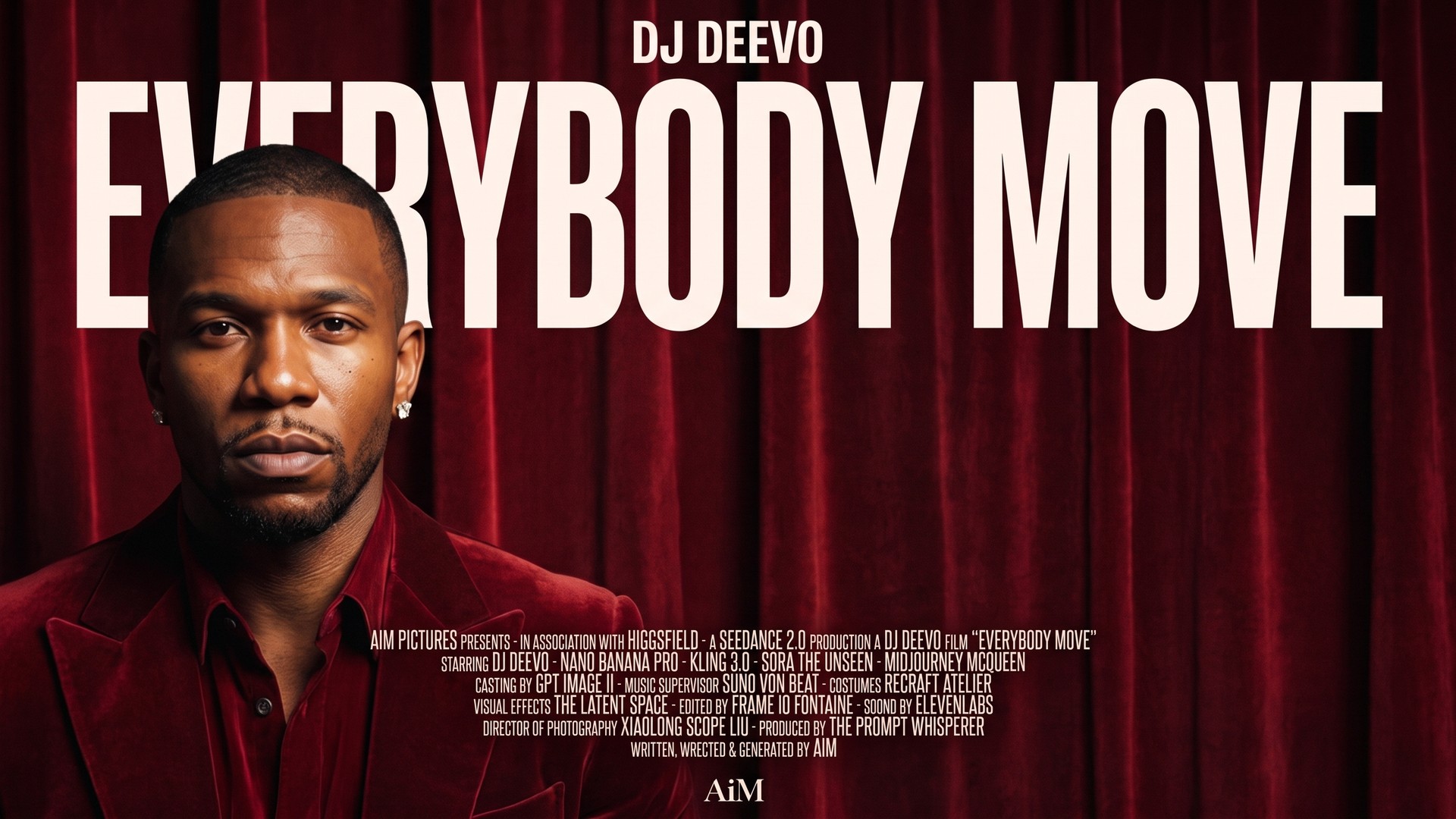
The new issue
This month we made a music video — start to finish, with AI. Not a slideshow, not a lyric card: a real performance video, a performer singing the song across a run of worlds, cut to the beat. Here’s how it’s built, and — just as importantly — what stays human.
Start with the song
Everything is locked to a finished master track. Before a single frame is generated, we map the song: intro, verses, hooks, the drop, the outro. That map becomes the edit skeleton — it tells us how many worlds we need, how long each performance beat runs, and where the cuts have to land. The music leads; the visuals follow.
One performer, many worlds
The trick to a music video that feels real is identity consistency. The same performer has to show up in every location and still be unmistakably the same person. So we lock the performer as a reference and carry it through every generation — a rooftop at dusk, a flooded hallway, a desert at golden hour, a neon-soaked basement — and the face, the wardrobe, the presence all hold.
That’s what turns a set of clips into a video: a single character you follow through surreal, impossible worlds you could never afford to build or shoot for real.
Lipsync that actually syncs
A convincing music video lives or dies on the mouth. We generate performance clips that sync to the vocal — the performer genuinely sings the line, not a loose approximation that drifts off the beat. Then, in the edit, every cut is placed against the track so the visuals hit when the song hits.
The song is human. The performance coverage is AI. The taste that decides which take makes the cut is human again.
Cut to the beat
Coverage is only half the job. The other half is editorial — and it’s where the whole thing comes alive. Because generating another angle or another world is fast and cheap, we can over-cover, then be ruthless in the edit: hold on the hook, cut hard on the snare, switch worlds on the drop. The video is assembled to the music, then graded like a film so every world sits in one coherent look.
What stays human
This is the part that matters. AI produced the coverage — but the song, the concept, the world-building, the performance direction, and every editorial decision are ours. Every frame runs through the same craft check as our commercial work: if a shot looks AI-generated, it doesn’t ship.
Why brands should care
An artist, a label, or a brand can now get a fully-realised music video — multiple worlds, real performance, film-grade grade — in a fraction of the time and cost of a traditional shoot, and iterate on the cut as many times as they want. That’s not a novelty. That’s a new production economics for music.
Press play above to watch this month’s video, then read Why AI? for the studio philosophy behind all of it.
Frequently asked
Can you make a music video with AI?
Yes — a full performance music video: a performer lip-syncing to a finished master track across multiple worlds, cut to the beat. The song and the creative direction are human; AI produces the coverage.
How does AI lipsync work in a music video?
We map the finished track to segments, lock a consistent performer as a reference so the face stays the same across every world, generate performance clips that sync to the vocal, and edit to the beat in post.
How long does an AI music video take?
A fraction of a traditional shoot. With no crew, location booking, or shoot calendar, we build multiple worlds and iterate on cuts in days rather than weeks.
Does an AI music video look cheap?
Not when it’s made right. Every frame is graded like a film still and runs through a craft check — if a shot looks AI-generated, it doesn’t ship.
Got a track? We’ll build the video around it. Book a 30-minute call.