
The Journal · Issue 06 · Automotive
Sell the car before it exists.
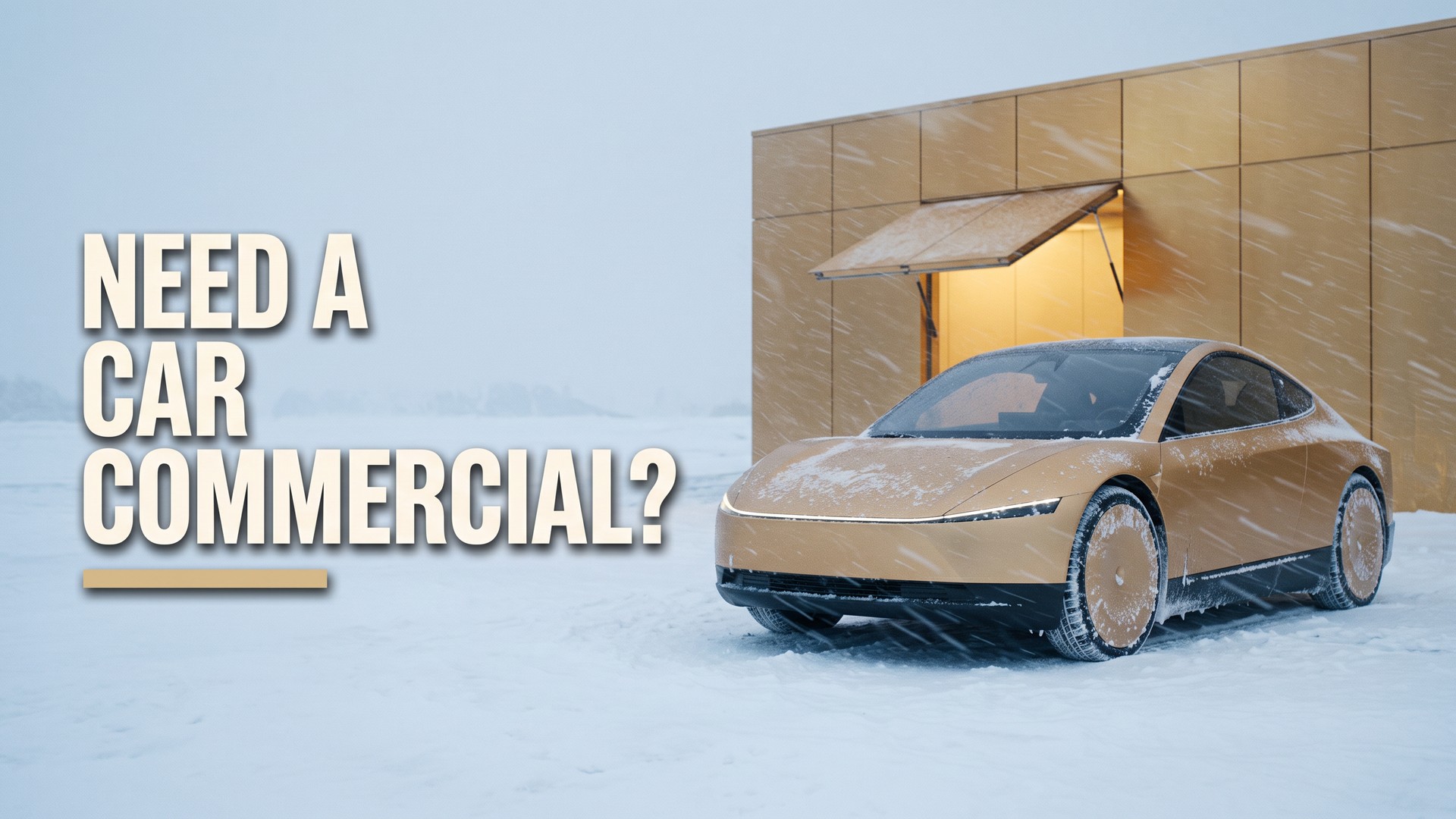
Spec ad · Tesla Cyber Cab
Automotive is the most expensive category in advertising, and it has a problem nobody talks about: the cars that most need a commercial are the ones you cannot film. This month’s issue is a spec spot we built for the Tesla Cyber Cab — a vehicle that, at the time of writing, you cannot borrow, drive, or put on a closed road.
Why car ads cost what they cost.
Almost none of the budget is the idea. It’s the logistics of putting a real object in a real place:
- The location. A closed road, a permitted circuit, or a salt flat — plus permits, marshals, and a weather contingency you pay for whether you need it or not.
- The camera car. A rigged tracking vehicle, an arm, and a driver good enough to hold a repeatable line at speed.
- The hero vehicle. Transported, prepped, detailed between takes, and often duplicated so a second unit can work in parallel.
- The crew. Dozens of people, on location, for days, at whatever the light gives you.
And the compounding cost: every new environment is another shoot. A tunnel and a frozen lake are two productions, two travel budgets, two weather windows.
In car advertising you aren’t paying for the shot. You’re paying to be standing somewhere.
The unreleased-product problem.
Now make it a car that hasn’t launched. Pre-production units are prototypes: camouflaged, embargoed, and usually not permitted to leave the building — let alone be driven hard on camera by an agency. So the launch film, the single most important asset of the entire campaign, has nothing to point a lens at.
The industry answer has been full CGI at a price that only a handful of brands can carry. That’s the constraint we set out to remove.
Build the car. Build the world.
We don’t film the vehicle, we build it — from design data if it exists, and from renders, photography, or concept art if it doesn’t. Once the car is built, the environment is just another build, and that changes the economics completely: a bronze-lit tunnel and a frozen lake cost the same.
Which means the creative decides the shot list, not the budget.
How the Cyber Cab spot is put together
The spot runs a deliberate two-act shape, which is the oldest grammar in car advertising and still the best:
- Act one — contained. A dark, bronze-lit tunnel. We withhold the car and give you fragments instead: the light bar waking up, a wheel turning, the sweep of a body panel, the empty interior. Warm, controlled, almost reverent. Then the full reveal, still indoors, still held.
- Act two — released. Hard cut to cold. A structure standing in snow, doors open, and the car goes out onto ice — drifting, throwing powder, wheels breaking traction, tail lights smearing through the mist.
- The end card. A hand-drawn Cyber Cab logotype over the car on the ice. Rough, marker-scrawled, deliberately at odds with the machined precision of everything before it.
Warm to cold. Contained to free. Precision to mess. That contrast is the whole ad, and it’s what makes a stationary object at the top of the film feel like a promise by the end of it.
What this changes for a launch.
- The campaign is ready before the product is. Announcement day arrives with the film already finished, approved, and cut for every placement.
- Variants stop being reshoots. New paint, new wheels, a different trim, a right-hand-drive market, a localised end card — changes in the build, not another week on location.
- You can test the idea. Two edits, two soundtracks, two endings, and real data on which one works, for far less than one shoot day.
- Nothing leaves your building. No prototype on a public road, no camouflage, no leak risk while a crew of forty stands around the thing you haven’t announced.
And it isn’t only cars. The same applies to any product with a launch date and no shootable unit — hardware, appliances, wearables, eyewear, furniture, packaging. If it exists as a design file, it can exist as a commercial.
Disclosure. This is a spec advertisement — conceived and produced by AiM as portfolio work, not in partnership with Tesla. Any marks shown do not signify a commercial relationship between Tesla and AiM.
If your product is intangible rather than unreleased, the opposite problem is covered in why does your tech company need a video — or start a project below.
Frequently asked
Can you make a car commercial for a vehicle that hasn’t been released?
Yes — that’s the case this is built for. A pre-release vehicle usually can’t leave the building, so there’s nothing to film. We build the car and the environment from design data, renders, or reference, so the commercial can be finished and approved before a single production unit exists.
Why are car commercials so expensive to shoot?
Because the cost is location, not idea: closed roads or a permitted circuit, a camera car and rigging, precision drivers, permits, weather contingency, and a hero vehicle transported and prepped. Every extra environment is effectively another shoot. Built environments remove that entirely — a lit tunnel and a frozen lake cost the same.
What do you need to make a commercial for an unreleased product?
Design data or CAD if you have it; otherwise renders, photos, or concept sketches — plus your brand guidelines and whatever you can say publicly. We build the object to spec, then design the world, motion, and sound around it. Nothing physical ships.
Is this a real Tesla advertisement?
No — it’s a spec ad, produced by AiM as portfolio work, not in partnership with Tesla. It does not signify any commercial relationship between Tesla and AiM.
Got something unreleased? Book a 30-minute call and we’ll scope the launch film.